Sheet D · How solar boats work
How Solar Boats Work: Electric Propulsion, Range and the Daily Energy Budget Explained
A solar boat collects its energy on the roof, stores some of it in batteries and spends it through an electric motor. How far a solar boat can go depends on one balance between what the sun delivers and what the hull costs to push. Here is that balance explained, step by step, with the numbers of a real ocean crossing.
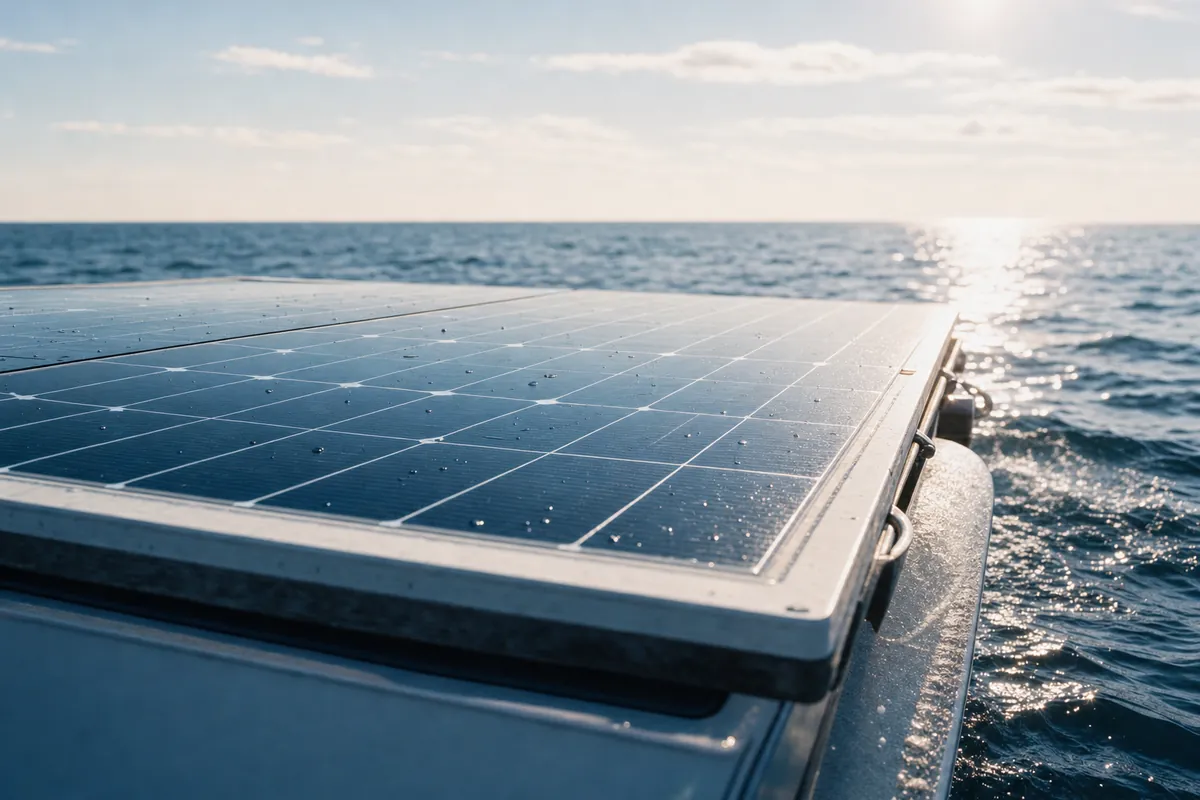
From sunlight to propeller in five steps
How far a solar boat can go comes down to five parts working together, from the roof to the water:
- Panels turn sunlight into direct current. A modern panel converts roughly a fifth of the light that falls on it.
- A charge controller keeps the panels at their most productive operating point and decides where the current goes.
- The motor takes what it needs first; any surplus flows into the batteries.
- The batteries store that surplus for cloudy hours and for the night.
- The propeller, turned by the electric motor, pushes the hull through the water.
Electric propulsion explained: from battery to propeller
To see how solar boats work, start below the roof: a solar boat is an electric boat. The motor does not care where its current comes from: panels, batteries or a shore cable. What makes the boat solar is that the panels are its main, and often only, source of energy.
Electric propulsion suits boats well. They are quiet, they produce no exhaust, they deliver full torque from standstill and they turn most of their input into motion. A diesel engine turns only a small part of its fuel energy into work and loses the rest as heat; a good electric drive keeps the large majority of the energy it receives.
In solar electric propulsion, efficiency matters more than anywhere else, because every lost watt has to be collected from the sky first. That is why solar boats favour large, slow-turning propellers. They move a lot of water gently, which wastes far less energy than a small propeller spinning fast. On the ocean crossing of sun21, a belt drive geared each 8-kilowatt motor down so the carbon propeller turned no faster than about 800 times a minute.
Direct current all the way
Panels and batteries both work with direct current, and many solar boats use DC motors at the battery voltage. sun21 ran its two motors at 48 volts, the same as its battery banks, so no energy was lost converting between the two.
The daily energy budget
Explained simply, every solar boat lives on a daily budget. Income is the energy the roof collects between sunrise and sunset. Spending is what the motors and everything else on board use in 24 hours. If the two match, the boat can keep going for as long as the weather holds.
The income side is easy to overestimate. A panel's rating is its output in strong midday sun. Across a whole day, with the sun low in the morning and evening and clouds passing over, a flat roof at sea collects only a fraction of its peak rating multiplied by the hours of daylight. The latitude, the season and the weather move that fraction a lot.
The ocean voyage of sun21 makes it concrete. Its roof was rated at about 10 kilowatts. On the winter crossing it put between 600 and 920 ampere-hours a day into the 48-volt system, which is roughly 29 to 44 kilowatt-hours. Spread over 24 hours, that is an average of something like 1.2 to 1.8 kilowatts available around the clock, a small share of what the two motors could have drawn.
An example energy budget: one day on the trade winds
| Item | Value | How it is worked out |
|---|---|---|
| Solar income per day | about 29–44 kWh | 600–920 Ah × 48 V, from the builder's fact sheet |
| Average power over 24 h | about 1.2–1.8 kW | daily income ÷ 24 hours |
| Motor power available | 16 kW | 2 × 8 kW, never used in full on the crossing |
| Battery capacity on paper | about 50 kWh | 2 × 520 Ah × 48 V; usable share is smaller |
| Speed held | 5–6 knots | day and night, on the trade-wind route |
A worked example, not a measurement: the daily income comes from the published charge figures, and the averages assume all of it went into propulsion and the systems on board.
Why speed costs so much
Water is dense, and pushing a hull through it gets expensive quickly. For a displacement hull at moderate speeds, the power needed rises roughly with the cube of speed. Double the speed and the motor needs about eight times the power; go 20 percent faster and the bill rises by about 70 percent.
That steep curve, explained in one line, is why solar boats travel slowly on long trips: it is the heart of how solar boats work. A boat that cruises gently can live on its daily solar income. Push the throttle forward and the batteries empty within hours. sun21 held five to six knots, about the pace of a cruising sailing yacht, because that speed fitted inside its budget.
Hull shape moves the whole curve. Long, slim hulls, often in a catamaran layout, produce less wave drag than short wide ones, and they leave room between them for a large flat roof. Light construction helps too: every kilo carried is a kilo the motor has to push.
Batteries and the night
Batteries let solar electric propulsion run around the clock. During the day the panels supply the motor and the surplus charges the bank. After sunset the bank alone carries the boat until the panels wake up again.
The size of the bank sets how much bad weather the boat can ride out. A small bank covers one night. A larger one covers a grey day as well. Long-range solar boats today use lithium batteries, which store several times more energy per kilo than the lead batteries of 2006 and accept charge faster, so more of a short sunny spell ends up in storage.
Range: how far can a solar boat go?
How far a solar boat can go on sunlight alone has no fixed limit. If the daily income covers the daily spending, it can keep going for as long as the boat and crew hold out. Tûranor PlanetSolar went around the world in 584 days, and the only fuel on board was for cooking and emergencies.
The catch is speed: how far a solar boat can go in a day depends on how fast it tries to get there. Its practical range is set by the speed its energy budget allows, the weather on the route and the size of its batteries. In a week of heavy cloud even a big roof collects little, and a sensible skipper slows down to stretch the stored charge.
On short routes, how solar boats work day to day looks different. A solar ferry crossing a lake or river many times a day uses its roof to cover part of its consumption and tops up from shore at night. Range is then measured in crossings per charge, and the sun lowers the running costs. The solar boat world records collect both kinds of milestones, and the sun21 solar catamaran shows the hardware of one ocean-going example.
Questions about how solar boats work
Q.01Can a solar boat run at night?
Yes, on its batteries. The panels charge them during the day, and after dark the batteries drive the motor until the sun is back.
Q.02How fast do solar boats go?
Long-range solar boats usually cruise at about five to eight knots, because the power needed rises steeply with speed. Small racing boats go much faster over short distances.
Q.03How far can a solar boat go?
With enough sun and a modest speed there is no fixed limit: Tûranor PlanetSolar sailed 60,023 kilometres around the world on solar power. The weather and the battery size decide how far it gets in a given week.
Q.04Do solar boats need a generator?
Not necessarily. sun21 and Tûranor PlanetSolar crossed oceans without burning fuel for propulsion. Many commercial solar boats add shore charging, and some carry a small backup generator.
Q.05Why are so many solar boats catamarans?
Two slim hulls create little drag, and the deck between them gives a large flat surface for panels.