Sheet B · The boat
The sun21 Solar Catamaran: Design, Solar Panels and Batteries of an Ocean-Going Boat
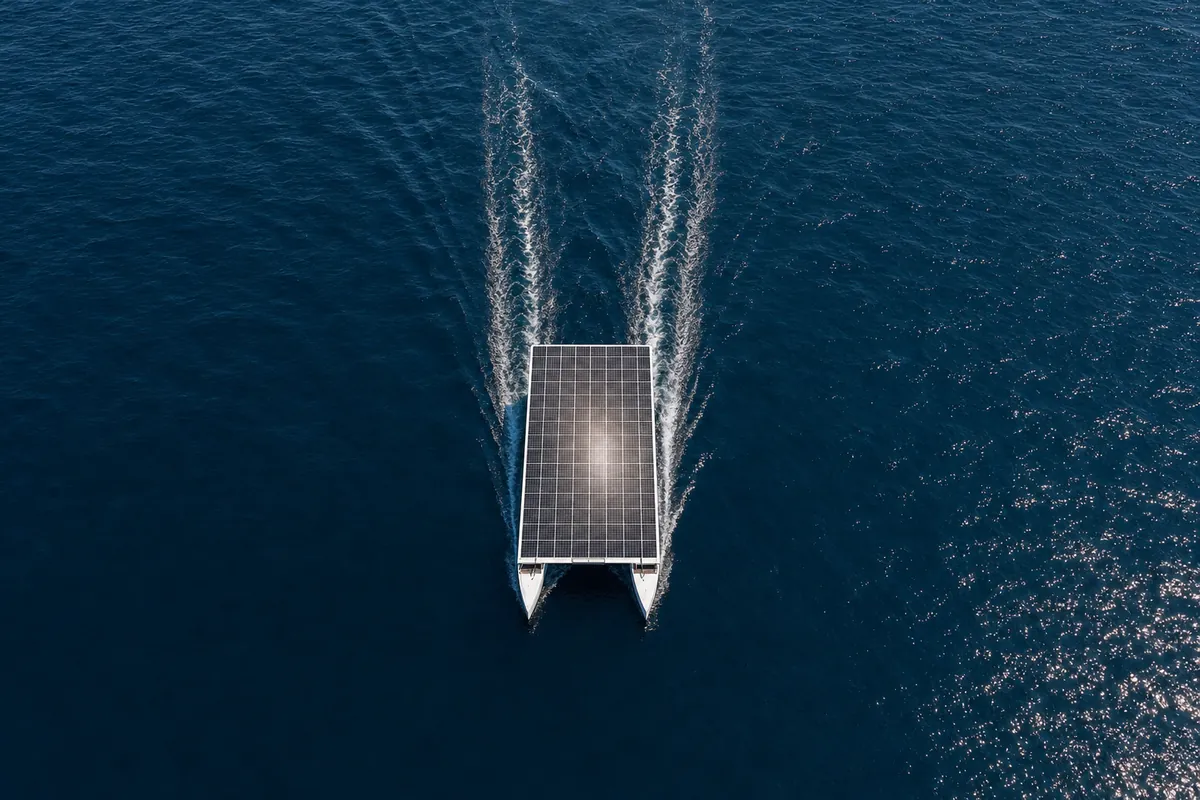
sun21 was a fourteen-metre solar catamaran with a roof of 48 glass panels, one battery bank and one electric motor in each hull, and nothing else to push it along. This sheet takes the boat apart: how a solar catamaran is built for the open sea, what the roof could deliver and how the batteries carried it through the night.
From lake ferry to ocean boat: the design brief
How a solar catamaran is built for an ocean was first worked out on Swiss lakes: the design of sun21 did not start with the Atlantic. In 1996 the Swiss boatbuilder Mark Wüst began drawing solar passenger boats for the Swiss national exhibition, Expo.02. His yard, MW-Line, built four solar catamarans for the show, and during its 156 days they carried more than a million passengers across the Swiss lakes.
Those boats proved the basic layout: two slim hulls, a flat roof of panels between them, batteries low down and electric motors at the stern. They had never been asked to leave sight of land, though. For an ocean voyage the yard took its Aquabus C60 model and changed what mattered at sea: a stronger and larger roof carrying more panels, extra stiffness in the roof and the hulls, living quarters below, and two small steering cabins.
Construction began in February 2006. By the end of September the boat was in the water, and on 16 October 2006 it was christened sun21 in Basel.
Solar catamaran specifications at a glance
| Item | sun21 | What it meant at sea |
|---|---|---|
| Type | MW-Line Aquabus C60 | A proven lake-ferry hull, reinforced for open water |
| Length × beam | about 14 m × 6.6 m | Wide stance, so the boat rolled little in a swell |
| Weight | about 12 t | Mostly hulls, roof and batteries |
| Draught | up to 1 m fully loaded | Shallow enough for rivers and small harbours |
| Solar panels | 48 glass modules, 214 W peak each | About 65 m² and 10.3 kW peak in full sun |
| Batteries | one 48 V lead-gel bank of 520 Ah per hull | Enough charge for a night at cruising speed |
| Motors | 2 × 8 kW DC, one per hull | Each hull could run on its own |
| Propellers | carbon fibre, in tunnels in the hulls | Slow-turning for better efficiency |
| Speed | 5–6 knots cruising, day and night | About 9–11 km/h, the pace of a sailing yacht |
Figures from the builder's fact sheet and the boat description published by the transatlantic21 project. The published top speed differs between them (7 and 9 knots), so it is left out here.
Two hulls and a roof: why a catamaran
Each of the two hulls was about 1.4 metres across at its widest, long and narrow like a canoe. A slim hull pushes less water aside than a broad one, and at the low speeds a solar boat lives at, every watt saved on drag is a watt that can go into the batteries for the night.
Four rectangular aluminium beams tied the hulls together. On them sat a frame of tubes with a plywood deck, and over the deck the roof carried the panels. That arrangement shows how a solar catamaran is built around its roof, and it is the layout's real advantage: a large, flat, stable surface high above the water, with nothing in the way of the sun.
Weight was spread low. The batteries, the heaviest single items on board, sat inside the hulls near the waterline, and in a long Atlantic swell that ballast helped keep the boat steady.
Life inside the hulls
The boat slept five to six people for the long passage and had room for several dozen visitors on deck in port. One hull held the galley, the other the washroom, with berths fitted around them. The two steering cabins gave the watch a dry place to stand.
The solar panels on the roof
The solar panels on sun21 were 48 glass modules with monocrystalline cells, each rated at 214 watts peak. Together they came to 10,272 watts, spread over about 65 square metres. The builder listed the array as two sets of about 5 kilowatts each.
A peak rating describes the output in full midday sun with the panel square to it. On a moving boat at sea that happens only for an hour or two at a time. Morning and evening light comes in low, cloud cuts the output sharply, and salt spray settles on the glass. Across a real day the roof delivered a fraction of its peak, and the crew planned with that fraction.
The fact sheet put it in battery terms: on the winter crossing, the panels put between 600 and 920 ampere-hours a day into the batteries. That covered the motors and everything else on board, from the radar and satellite phones to the lights and the coffee machine.
Solar catamaran batteries: two banks, two boats in one
The solar catamaran batteries came in two halves, one bank per hull: 2-volt lead-gel cells wired up to 48 volts, rated at 520 ampere-hours over a five-hour discharge. At 48 volts that is roughly 25 kilowatt-hours per hull on paper, a little under 50 kilowatt-hours for the boat.
Lead batteries do not like being emptied completely, so the usable share of the solar catamaran batteries was smaller. It was still enough to carry the catamaran from dusk to dawn at cruising speed, with a margin for a grey morning.
Splitting the system in two was a safety decision. Each hull had its own panels, batteries and motor, so a fault on one side left the other running. If a motor had to be repaired at sea, sun21 could carry on with one hull doing the work.
Why lead and not lithium
In 2006 lithium cells for boats were rare, costly and untested on a long ocean passage. Lead-gel batteries were heavy, but sealed, robust and well understood. Their weight, placed low in the hulls, also worked as ballast.
Motors, belts and slow propellers
Two direct-current motors of 8 kilowatts each, one per hull, drove the boat. They ran on the same 48-volt system as the batteries, with no converter stage in between to waste energy.
A belt drive geared the motor down so the carbon-fibre propeller turned slowly, at no more than about 800 revolutions per minute. A large propeller turning slowly moves a lot of water gently, and that is far more efficient than a small one spinning fast. The propellers sat in tunnels shaped into the hulls, protected and close to the hull bottom.
At full power the motors could draw 16 kilowatts, more than the roof could ever supply. In practice they ran at a fraction of that. Holding five to six knots took only a small share of the available power, and that gap between what the roof gave and what the hull needed is what made the Atlantic crossing possible.
How a solar catamaran is built to cross an ocean
Put the pieces together and you see how a solar catamaran is built for an ocean: the design reads like a list of compromises made in favour of energy. The hulls are slim because drag costs power. The roof carries as many solar panels as the boat allows because every square metre adds charge. The batteries sit low because their weight has to go somewhere useful. The speed is modest because a hull's resistance climbs steeply as it goes faster.
None of these choices is exotic. Modern ocean-going solar catamarans follow the same pattern with lighter lithium batteries, more efficient panels and electronics that track the sun's output minute by minute. How solar boats work explains the physics behind that balance, and the records of later solar boats show how far they have taken it.
Questions about the boat
Q.01How big was the sun21 solar catamaran?
About 14 metres long and 6.6 metres wide, with a draught of up to one metre when fully loaded. It weighed around 12 tonnes.
Q.02How many solar panels did sun21 have?
48 glass modules with monocrystalline cells, each rated at 214 watts peak. Together they covered about 65 square metres of roof and produced up to about 10.3 kilowatts.
Q.03What batteries did the solar catamaran use?
Lead-gel batteries: one 48-volt bank of 520 ampere-hours in each hull. Lithium was still rare on boats in 2006.
Q.04Who built sun21?
The Swiss yard MW-Line, founded by Mark Wüst, which had earlier built four solar passenger catamarans for the Swiss national exhibition Expo.02.
Q.05Could sun21 run on one motor?
Yes. Each hull had its own panels, battery bank and motor, so the boat could carry on with one side working if the other needed repair.