Sheet A · The sun21 crossing
The sun21 Atlantic Crossing: Route, Record and Every Port from Basel to New York
In 29 days on the open ocean, a 14-metre catamaran with a solar roof and no fuel on board crossed from the Canary Islands to Martinique: the first solar powered Atlantic crossing by a motor boat. Here is the whole route, port by port, and what the record proved.
A boat that left its fuel tank behind
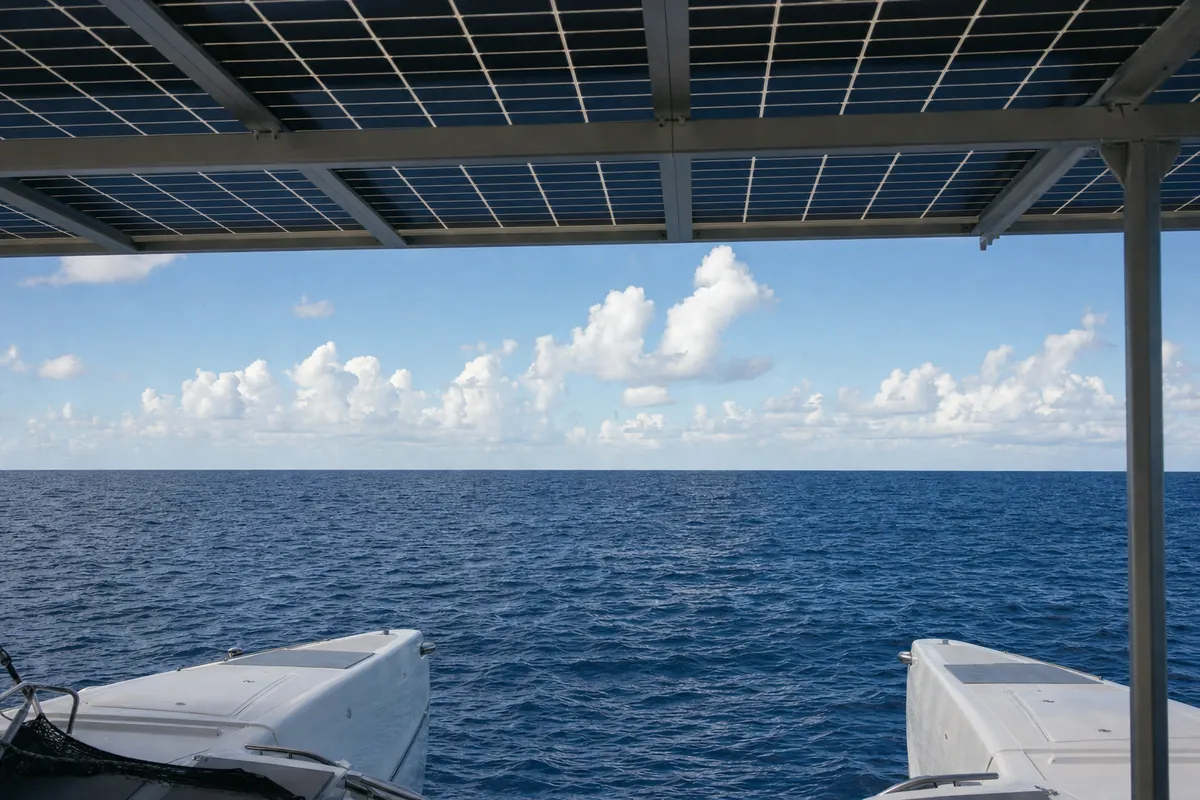
sun21 was a 14-metre catamaran built by the Swiss yard MW-Line and fitted for one job: the first solar powered Atlantic crossing, made on sunlight alone. Its roof carried about 65 square metres of solar panels with a peak output of around 10 kilowatts. Each of the two hulls held a bank of lead-gel batteries and one 8-kilowatt electric motor.
There was no generator on board and no reserve of diesel. If the panels and batteries could not keep the motors turning, the boat would simply drift. That plain rule shaped every decision of the voyage, from the season it sailed in to the speed it held.
From the Rhine to Seville: the route before the record
The sun21 solar boat route began far from the sea. The catamaran was christened in Basel in October 2006 and went down the Rhine under its own power, through Germany and the Netherlands, to Rotterdam. Those river kilometres were a long sea trial for the motors and the panels.
A slow solar boat has little business in the Channel and the Bay of Biscay in late autumn. In Rotterdam the catamaran was lifted onto the freighter Joanna and carried south to Cádiz. From there it ran up the Guadalquivir and reached Seville on 21 November 2006.
Seville was the place for the presentation and the farewell. On 3 December 2006 the ocean voyage started from Puerto Sherry at Chipiona, near the mouth of the Guadalquivir, with a crew of five. The first leg to the Canary Islands was rougher than planned: a storm sent the boat into Casablanca, Christmas was spent on Lanzarote, and Las Palmas on Gran Canaria became the last port before the open Atlantic.
The sun21 voyage in dates
| Date | Place | What happened |
|---|---|---|
| 16 Oct 2006 | Basel, Switzerland | Christened, leaves down the Rhine |
| Autumn 2006 | Rotterdam, Netherlands | Loaded onto the freighter Joanna |
| 21 Nov 2006 | Seville, Spain | Arrives up the Guadalquivir from Cádiz |
| 3 Dec 2006 | Chipiona (Puerto Sherry), Spain | Ocean voyage starts, crew of five |
| Dec 2006 | Casablanca, Morocco | Storm stop on the way to the Canaries |
| Early Jan 2007 | Las Palmas, Gran Canaria | Last European port |
| 2 Feb 2007 | Le Marin, Martinique | Atlantic crossing complete after 29 days |
| Spring 2007 | Miami, United States | Reached 117 days after leaving Chipiona |
| 8 May 2007 | New York, United States | Ties up at North Cove Marina |
The sun21 solar boat route in this table follows the ports and dates on record; the exact day in Rotterdam and Las Palmas was not published in the sources used here, and the track between ports on the chart is approximate.
The Atlantic crossing: 29 days on the trade winds
From Las Palmas the boat headed south-west into the trade-wind belt, one of the sunniest stretches of open water on earth. The wind there blows steadily from the north-east, which pushes a slow boat in the right direction and keeps the sky clear for much of the day.
sun21 held five to six knots around the clock. During the day the roof supplied the motors and topped up the batteries; at night the batteries alone carried the boat until sunrise. Cloud meant slowing down to save charge, and a bright afternoon meant a chance to run a little faster.
On 2 February 2007, twenty-nine days after leaving the Canaries, sun21 tied up in Le Marin on Martinique. No motorised boat had crossed the Atlantic before without burning a drop of fuel.
Living on a solar energy budget
The crossing worked because the crew treated energy like water on a long passage. The roof could deliver up to about 10 kilowatts in full sun, and the two motors could draw 16 kilowatts between them at full power. Running flat out was never the plan. At five to six knots the motors needed only part of that, which left a surplus on a clear day.
That surplus went into the batteries: in each hull a 48-volt lead-gel bank rated at 520 ampere-hours. Together the two banks held enough charge to keep the boat moving through the night at cruising speed and still have a margin left when the sun came up.
The weather decided the daily run far more than any timetable. A grey morning meant easing the throttle and waiting for the cloud to break. A clear afternoon meant a faster hour or two and full batteries before dark. The boat kept moving day and night for the whole ocean leg.
Why lead-gel batteries
In 2006 lithium batteries for boats were rare and expensive. Lead-acid banks were heavy, but they were proven at sea, and sitting low in the hulls their weight helped the catamaran stay steady in a long swell.
Five people and no engine noise
Five people sailed the ocean voyage from Chipiona. Life on board followed the battery gauge: watches were kept around the clock, as on any boat at sea, but the decisions that mattered were about charge, cloud and speed.
What visitors noticed first in port was the quiet. With no diesel engine there was no exhaust and no vibration, only the hum of two electric motors and the water along the hulls.
Up the American coast to New York
After the crossing the catamaran worked north through the Caribbean and reached Miami 117 days after leaving Chipiona. The last leg ran up the American east coast in spring, with longer days and more sun on the roof than the boat had seen in Europe in winter.
On 8 May 2007 sun21 tied up at North Cove Marina in Lower Manhattan. Counted from Chipiona, the boat had covered roughly 7,000 nautical miles on solar power.
Why the record still stands out
It was the first solar powered Atlantic crossing, and it still stands out for a simple reason. Plenty of sailing boats carry solar panels, and plenty of electric boats run on lakes. What sun21 showed was that a motor boat with no fuel at all could plan and finish an ocean passage, as long as it matched its speed to the energy the roof could collect.
That idea carried straight into larger projects. A few years later the much bigger Tûranor PlanetSolar went around the world on the same principle. The solar boat records since then follow that line, and the solar catamaran itself explains the hardware that made the crossing possible.
Questions about the crossing
Q.01How long did the sun21 Atlantic crossing take?
The open-ocean leg from Las Palmas on Gran Canaria to Le Marin on Martinique took 29 days and ended on 2 February 2007. The whole voyage from Chipiona to New York took about five months.
Q.02Where did sun21 start its voyage?
The boat was christened in Basel and went down the Rhine to Rotterdam. The ocean voyage itself started from Puerto Sherry at Chipiona, near Cádiz, on 3 December 2006.
Q.03Did sun21 sail through the Mediterranean?
No. A freighter carried the catamaran from Rotterdam to Cádiz, and from there it ran up the Guadalquivir to Seville.
Q.04How many people were on board?
A crew of five sailed the ocean voyage from Chipiona.
Q.05How did sun21 keep moving at night?
The roof charged two 48-volt lead-gel battery banks during the day, one in each hull. At night the batteries alone powered the two electric motors until the sun was back.