Sheet C · Records
Solar Boat Records: World Firsts, Atlantic Crossings and the First Circumnavigation
Fifty years separate a small solar boat on an English pond from a 31-metre catamaran that went around the planet on sunlight. Here are the solar boat world records in between: who set them, on which route, and what each one actually proved.
Reading a solar boat record
Solar boat records come with conditions attached, and the conditions matter more than the headline. Most solar boat world records are first-of-their-kind voyages, confirmed afterwards by Guinness World Records or by contemporary reporting. A few are speed records over a fixed route.
The key word is usually "solar only". It means the boat used no fuel for propulsion during the record leg. It does not always mean the boat reached the start line under its own power: sun21 was carried part of the way through Europe on a freighter, and that leg was never part of its claim.
Solar boat world records: the timeline
| Year | Boat | Record or first | Route |
|---|---|---|---|
| 1975 | Solar Craft I | Usually named the first solar boat | England |
| 1996 | Malt's Mermaid | First solar Pacific crossing, 138 days | Salinas, Ecuador → Tokyo |
| 2007 | sun21 | First motorised Atlantic crossing on solar power alone, 29 days | Las Palmas → Le Marin, Martinique |
| 2010 | Tûranor PlanetSolar | Atlantic crossing on the world voyage, about 27 days | Las Palmas → Saint Martin |
| 2012 | Tûranor PlanetSolar | First solar circumnavigation, 584 days, 60,023 km | Monaco → Monaco, westward |
| 2013 | Tûranor PlanetSolar | Fastest solar Atlantic crossing, 22 days 12 h 32 min | Las Palmas → Marigot, Saint Martin |
The year of Solar Craft I is given as 1974, 1975 or 1976 depending on the source; 1975 is the most common. The day count of the Pacific voyage also differs between sources (138 or 148 days); the published dates, 20 March to 5 August 1996, give 138.
The first solar boats
The story usually begins in England. Alan T. Freeman, an inventor who later built solar bicycles and cars, launched a small solar catamaran called Solar Craft I in the mid-1970s. It was a few metres long and slow, crawling along at little more than walking pace, but it moved on sunlight and nothing else.
Through the 1980s and 1990s solar boats stayed on lakes, rivers and university test basins. Student teams began racing small solar boats. Panels were expensive and weak, and a useful boat needed calm water and a short trip.
The Pacific in 1996
The first long ocean voyage on solar power went across the Pacific. The Japanese sailor Kenichi Horie, already famous for a solo Pacific crossing under sail in 1962, left Salinas in Ecuador on 20 March 1996 in a small solar boat named Malt's Mermaid. Its hull was built partly from recycled aluminium cans, and its panels covered only about 12 square metres.
He reached Tokyo on 5 August 1996, roughly 16,000 kilometres later. It was a one-man voyage in a light craft, helped by ocean currents, and Guinness lists it as the fastest solar Pacific crossing.
sun21 and the Atlantic, 2007
Ten years later the Atlantic followed, with a different kind of boat. sun21 was a 14-metre motor catamaran with a crew of five, built from a passenger-boat design. It left Las Palmas on Gran Canaria and reached Le Marin on Martinique on 2 February 2007, after 29 days on the trade-wind route.
It is widely recorded as the first motorised Atlantic crossing powered only by the sun. The boat then carried on through the Caribbean and up the American coast to New York. The sun21 solar boat route has its own sheet, port by port.
Circumnavigation: the first solar boat around the globe
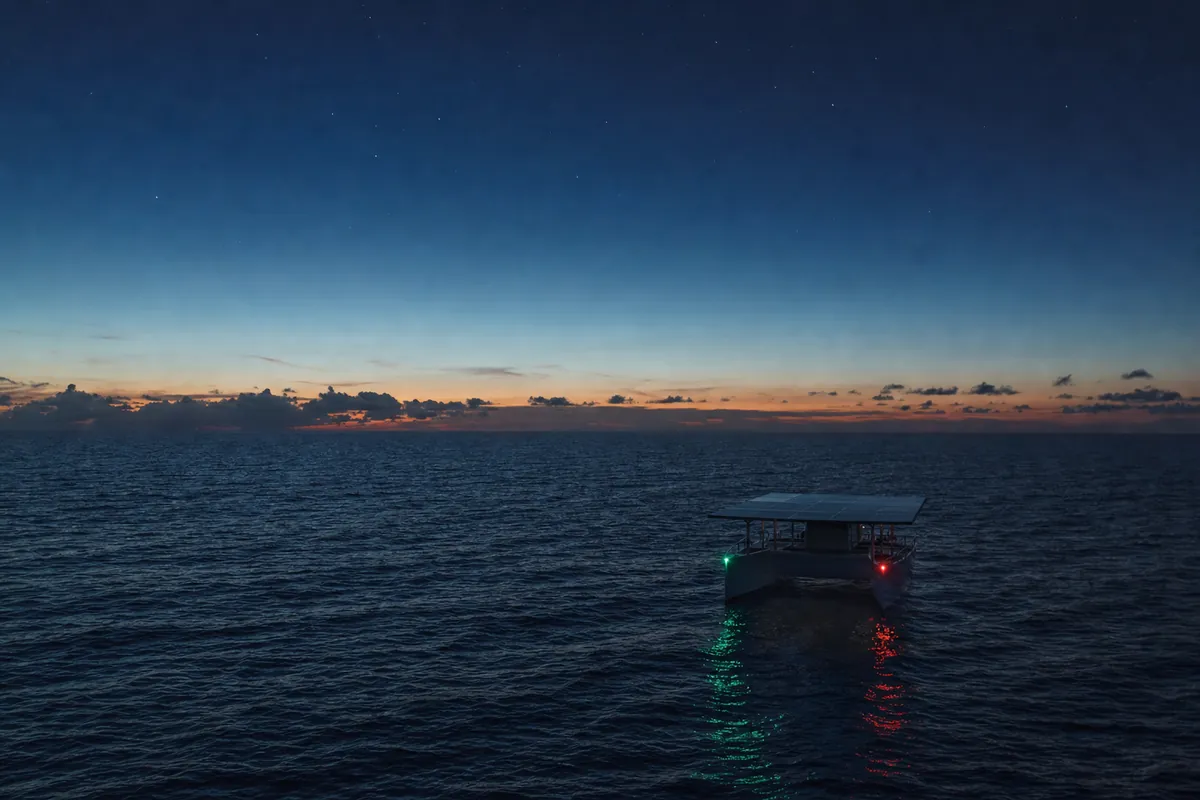
The biggest of the solar boat records belongs to Tûranor PlanetSolar. The catamaran was built by Knierim Yachtbau in Kiel and launched on 31 March 2010: 31 metres long, with about 537 square metres of solar panels on a deck that could extend outward at sea. It was, and for years remained, the largest solar boat afloat, and it set out to become the first solar boat to circumnavigate the globe.
On 27 September 2010 it left Monaco heading west. It crossed the Atlantic, passed through the Panama Canal, crossed the Pacific and the Indian Ocean and came back through the Suez Canal and the Mediterranean. On 4 May 2012 it returned to Monaco after 584 days and 60,023 kilometres. It was the first solar boat to circumnavigate the globe, and the voyage still tops the list of solar boat world records.
Size changes the numbers
PlanetSolar carried more than eight times the panel area of sun21 and weighed many times more. More roof means more energy collected each day, and a long, slim hull moves that weight through the water with little drag, so the bigger boat could hold a steady pace day after day.
Solar boat Atlantic records after 2007
PlanetSolar crossed the Atlantic twice. The first time was during the world voyage in 2010, from Las Palmas to the Caribbean in about 27 days. In 2013 it sailed the route again with the aim of a speed record and made it from Las Palmas to Marigot on Saint Martin in 22 days, 12 hours and 32 minutes, more than four days faster than its own first run.
That 2013 time is the fastest Atlantic crossing on solar power recorded by Guinness. After the circumnavigation and the speed record, the boat turned to research: from 2015 it sailed as Race for Water, a platform for studying plastic pollution in the oceans.
Records closer to everyday use
Not all solar boat records are long voyages. In January 2017 the 20-metre solar ferry Aditya entered service on the backwaters of Kerala in India, between Vaikom and Thavanakkadavu, carrying up to 75 passengers on a short daily route. Boats like it measure success in fuel saved and crossings made each day.
That is where solar boats are spreading fastest today: ferries, tour boats and small workboats on sheltered water, with batteries and charge from shore to back up the roof. The long voyages proved the principle, and how solar boats work shows why it holds on a short route as well as across an ocean.
Questions about solar boat records
Q.01What was the first solar boat to circumnavigate the globe?
Tûranor PlanetSolar, a 31-metre catamaran. It left Monaco on 27 September 2010 and returned on 4 May 2012 after 584 days and 60,023 kilometres.
Q.02Which solar boat crossed the Atlantic first?
sun21, a 14-metre Swiss catamaran. It reached Martinique from the Canary Islands on 2 February 2007 after 29 days, with no fuel used for propulsion.
Q.03What is the fastest solar Atlantic crossing?
22 days, 12 hours and 32 minutes, set by Tûranor PlanetSolar between Las Palmas and Saint Martin in May 2013.
Q.04Has a solar boat crossed the Pacific?
Yes. Kenichi Horie sailed the small solar boat Malt's Mermaid from Ecuador to Tokyo between March and August 1996.
Q.05What was the first solar boat?
Solar Craft I, built by the English inventor Alan T. Freeman and usually dated to 1975, is generally named as the first.